

Mum and dad give their daughter, Joanne $800k to buy a house. She then marries the good-looking Ken. Ten years later Joanne and Ken divorce. The house is still worth $800k. It is the only asset of the marriage.
Sadly, the Family Court gives Ken $400k. The Family Court is not interested that the money is a gift from Joanne's mum and dad. Instead, lend the child the money. Do not make gifts to children. (Even if you die many years after their divorce your daughter still loses some of your money.)
Mum and dad lend $800k to their daughter, Joanne. Joanne signed a legally prepared Loan Agreement built on Legal Consolidated's website. Joanne purchases a house with the money. She marries the handsome Ken. Ten years later they divorced. The house is still worth $800k. It is the only asset of the marriage.
The Family Court is shown the Loan Agreement. The Family Court gives Ken nothing. This is because the assets of the marriage are nil. ($800k - $800k = nil.)
To protect your loan build a legally prepared Loan Agreement - on a law firm's website. Homemade loan agreements may not work. They carry less weight with the Family Court and Bankruptcy Court. Why take the risk?
There is nothing wrong with helping our children financially. It could be for their first car, grandchildren's school fees, a holiday, medical expenses, non-concessional superannuation contribution or a property.
It is becoming more popular to help our children with a home deposit. But simply giving away the money has risks. It is important to protect the money in case your child:
1. divorces
2. go bankrupt
3. suffer from drugs
4. vulnerable or suffer a mental condition
5. stop loving you - ‘King Lear' gives his daughters his Kingdom for their love, but they abandon him
6. you run out of money yourself, in your old age
Never ‘give’ your children money. Always ‘lend’ them money ‘payable on demand’. Get it back if something goes wrong. Treat yourself like you are a bank, and your children are taking out a loan.
Creating a loan agreement for your children:
With loans to children, never rely on a verbal agreement. Press the above Start for free button and build a Parent lends Money to a Child Loan Deed.
We are Australia’s only law firm website, directly, providing legal documents online.
https://legalconsolidated.com.au/divorce-protection-trust-in-your-will/
Q: Under "Payment Date" I currently have your default words "Payable on demand as demanded by the Lender". It does sound a little threatening. My situation is that I do not wish the loan to be repaid. But rather my son's entitlement under my Will is reduced by the debt amount when that time comes. My son is a beneficiary in my Will, alongside with our two other children - equally shared.

A: You are at war, Neville Chamberlain. Your son is only one of the enemies:
War is ugly. Toughen up to Winston Churchill level. Do not be weak:
Dad, let me be clear. Your son either signs it, as it is drafted. This is by your lawyers, Legal Consolidated. Or you do not lend him the money.
Your son and his wife are free to go off to their bank, instead. At the bank, the young man will be taught manners.
Free resources to help protect young and vulnerable children:
Q: The bank is lending money for my son and his girlfriend to buy a home. I am also loaning $283,000 to them. We are going to do the same for our daughter when she gets older. How does the Loaning Money to a Child Agreement incorporate these expectations?
A: It does not. You are not writing a Charles Dickens novel here. You are merely lending $283,000 to your son. The Loan Agreement does not record what he does with the money. He may give the money to his Church. That is his call.
Consider the future loan to your daughter. You may die tomorrow. In this case, the loan to the daughter never happens. That is fine. Your son still owes you (or rather, your deceased estate) the money. So you are all square between your two children. Well done.
This stops you from having to redo your Will every time you lend money to a child.
Q: I am lending money to my son to buy a property with his wife. Ownership will be 99% in my son’s name and 1% in my daughter-in-law's name. There are no other debts. And the property will not have any mortgages. Should the Loan Agreement reflect this, or is it not relevant? Who is the Borrower?
A: I need to make four points.
Q; I am lending money to my daughter and her partner. A bank is also providing them with a loan. The bank is lodging a mortgage over the property (Property). The Bank will not want our parental Loan Agreement repayable "on-demand", such that we may get paid before the Bank does.
Does the Legal Consolidated Loan Agreement permit me to amend the Loan Agreement, to the satisfaction of the Bank?
A: We do not advise in this area. To fully understand the rights between other Lenders and you, speak with a securities or conveyancing lawyer.
Q: Our son and his wife of five years are renting a property. They are currently looking to purchase their own home.
I am loaning them $250,000 as a big deposit. Both our son and his wife are the Borrowers. So they will both owe me the money.
They will borrow a further $350,000 from a bank. The bank will put the first mortgage on the title.
Our son is a builder and like all business owners is at risk of going bankrupt. (We loved your asset protection strategies.) Good asset protection suggests the home be put only in our son's wife's name only.
We do not provide advice in this area. You need to speak with a securities or conveyancing law firm. The information below is only general in nature:
The Australian "Presumption of Advancement" is that where a husband:
In contrast, if the mum or child transfers money or assets to the dad then there is an assumption that this is a 'loan' – not a 'gift'.
A transfer from a father or a husband is presumed to be a gift, but not a transfer from a wife or a mother – this is presumed to be a loan to the father. A parent Loan Agreement to a child overrides this rebuttable presumption.
This is the case even if the couple is only engaged: Wirth v Wirth (1956) 98 CLR 228.
At Legal Consolidated, we take the view that this would also apply to de facto and same-sex couples under the authority of the Hong Kong case of Cheung v Worldcup Investments Inc [2008] HKCFA 78.
This has always been the law in Australia. We follow the English case: Grey v Grey (1677) 2 Swans 594; 36 ER 742.
This is messy. So it is best to either:
The Presumption of Advancement applies when a husband either:
to the purchase price of a property.
This is where the wife or child is given 'legal interest' in the property. In other words, the property is put solely in the name of the wife or the child.
The "presumption" is developed from a belief that:
Clients often start their asset protection journey by speaking with their accountant, financial planner or lawyer. Legal Consolidated has put this kit together to help these professionals on what needs to be done. Enjoy the free resources:
(Yes, I know that presumption of advancement is sexual discrimination. Please complain to your Member of Parliament.
Related to the above 'presumption' is where the:
The law presumes a 'resulting trust'. This is in favour of the other party. E.g. Mum and the child put money into a property. But the property is only in the child's name.
There is a presumption that Mum is the 'equitable' owner equal to her contribution. This can be rebutted. It is a mess of confusion, especially if you add bankruptcy, divorce and taxation matters into the mix.
Obviously, to avoid confusion and ambiguity:
1. talk with all your children together about the loans
2. never gift children money - only loan them money (this protects both you and them)
3. do not rely on homemade loans, IOUs, minutes or journal entries. Instead, build a Legal Consolidated Loan Agreement
In the movies, IOUs are often handwritten on a piece of paper. Sometimes, instead of a Loan Agreement, someone does a 'minute'. Both approaches fail. In Rowntree v FCT [2018] FCA 182 shows the additional care required to document even simple related-party transactions, such as loans. In this case, the taxpayer, a practising NSW lawyer, claimed he borrowed over $4m from his group of private companies. The Court said:
'Mr Rowntree has not deliberately chosen to ignore the law. His evidence presented to the Tribunal suggests that he genuinely believed that there were arguments to support his view that a loan was in existence.'
He failed. Only a legally prepared Loan Agreement satisfies the ATO, Bankruptcy Courts and Family Court.
In Russell and Dunphy v Dunphy [2023] NSWSC 282, the Court found that it was not enough to show that the money was advanced by the dead person and received by his son. The plaintiffs had to prove offer and acceptance in the formation of the alleged loan contract, as well as some outward behaviour that, viewed objectively, would establish a contract, let alone a loan.
You need a legally prepared Loan Agreement - which is a contract - to have the highest chance of it being upheld in court.
In Berghan v Berghan [2017] QCA 236, the son borrows money from his Queensland-aged father. The son refuses to pay it back.
In the first court case, the son successfully argued that the money was given to him as a gift. However, the Court of Appeal held that the amounts are loans.

The son’s company suffers financial stress. The son receives $98,000 from his Dad. The boy continues to borrow more money from Dad.
Later, the son borrows his father’s credit card. The boy racks up another $13,000 of debt.
His Honour said that Dad failed to prove a legally binding agreement. There was no paperwork. There was no written loan agreement. It was a gift.
The Judge said:
The Court of Appeal had a better sense:
The Court set aside the decision of the District Court. The Court said that the monies were paid with the understanding that they would be repaid. This is an “inescapable conclusion”. The transactions are a contract of loan. The Court gave judgment in favour of Dad of $286k including interest.
This is another example of elder abuse. The decision shows the perils of not signing a loan agreement. Going to Court - twice in this instance - is expensive and exhausting for the aging father.
What happens if the property is purchased in both your child’s and their partner’s names? Or, just in the name of the in-law for asset protection?
Then both your child and their partner should be parties to the Loan Agreement. They are both debtors.
You are lending money to an asset jointly owned. It is only fair—and legally necessary—that both owners are liable for the debt. If one refuses to sign, do not lend. Let them go to a bank.
Never lend money for a home purchase unless the people on the property title are the same people signing the Loan Agreement.
Most lawyers at Legal Consolidated believe it is best to have both your child and their partner named co-debtors on the Loan Agreement. This increases the chance that both are responsible for repaying the loan.
But not all our lawyers agree. There are arguments for and against adding your child’s spouse or partner to the loan as a principal debtor.
Evidence that the loan was completed some time ago: If the relationship breaks down, your child’s ex might claim the loan was only documented after the separation. Having both parties sign the agreement helps prove the partner knew about the loan.
Asset protection concerns: Families often use the “man of straw and woman of substance” strategy. One partner (e.g. your son) may be a business owner or professional, so the other, your daughter-in-law, holds the family's assets. If they separate, you may be left trying to recover funds from someone without money. Naming both as debtors reduces this risk.
The Loan Agreement is harsh: Our Loan Agreement is deliberately strict. It mirrors the kind of documentation used by banks. It has to — it must stand up in court. Your child might sign without hesitation. The partner might not. If they do not want to sign, they are welcome to borrow from a bank instead.
Relationship strain: Some in-laws do not appreciate being asked to sign something that looks like it came from a bank or a lawyer. That is fine. They do not have to accept your money. They can go to the bank themselves!
What If the Couple Separates Later? Many family loans are set up as revolving lines of credit. But if your child separates from their partner, you should not lend further money under the same Loan Agreement. You have received notice that the relationship has ended. It would be potentially unenforceable to keep using the original Loan Agreement for 'new' money you lend. If you want to lend more, build a new Loan Agreement, an added expense, where your child is the sole Debtor.
Guarantors are delicate creatures. While a guarantor can be hard to enforce, a co-debtor is equally liable and, therefore, usually easier to enforce.
Q: I read your comments that loans expire every 6 years (e.g. the ACT). One way to ensure that it continues is for the borrower to make a $1 payment before the end of the 6 years.
A: Yes. Alternatively, get the Borrower to sign a Deed of Acknowledgement of Debt. That freshens up the 6-year limitation rule. (Three years in the Northern Territory.)
Q: My daughter is married. I am going to lend her money to buy a home. Should she purchase the house only in her name? How does this benefit my daughter or me?
A: Your question does not relate to building a Loan Agreement. We do not give advice on this area of law. Below are some general comments only:
Q: What if my daughter and her husband separate? The $1m home goes into the matrimonial asset pot. But does the Family Court take into account the debt? This is the Legal Consolidated Loan agreement ($200k) and the Bank mortgage (500k). Therefore, is only the net figure of $300k available to the Family Court to share? ($1m - $700 = $300k equity)
A: We do not give advice on this area of law. You need to speak with a family lawyer.
Below is general advice only:
Q: How then is it more advantageous if the house and the loan agreement are in the name of my daughter only? How is keeping the partner out of it a benefit?
A: Again, we are not family lawyers. The family court puts everything in the pot. So, it may make little difference. But, as to the Loan Agreement, it is better to have as many people as possible be responsible for the debt.
Also, consider asset protection issues in having the home solely in the name of the 'person of substance'. And not in the name of the high-risk of bankruptcy husband.
However, we do not provide advice on these areas of law. The above is general advice only.
We do not advise on securities. We are only providing you with a Loan Agreement. The Loan Agreement authorises you to lodge and register securities.
A mortgage is similar to a caveat. But a Mortgage is more secure and enforceable. A caveat is indeed weaker than a mortgage. However, for advice speak to your conveyancer or securities law firm.
Yes. If you are making loans to children, even at the same time and for the same amount, you need separate Loan Agreements. Remember this document needs to stand up against the Family Courts, Bankruptcy Courts and other courts and tribunals. You contaminate the Loan by getting 'other people' co-owing the money with one of your children.
In the Legal Consolidated Loan Agreement, each person borrowing the money is required to pay it back. So if you were to do only one Loan Agreement then each child is guaranteed payment by the other children! Children do not want to be responsible for the debts of their siblings.
If you are lending to your child and their spouse, that is fine. They both are forced to pay back the loan. So if your child cannot pay, their spouse must then pay the loan.
You need to review your Will every few years. This is to make sure it still reflects your wishes.
However, you probably do not need to update your Will now that you have the Loan Agreement in place. In fact, an advantage of a Legal Consolidated Loan Agreement is that you do not need to keep updating your Will.
Let me explain, with this example:
Loving Dad is going to gift $300k to each of his three children. This is when they each buy their first home. Child one buys a home. And then child two buys a home. But before child three buys a home, Dad dies. The third child misses out on getting the $300k.
Instead, the loving dad lends the $300k as each child buys a home. So now child one and child two must pay back the $300k at dad's death. So, child 3 does not miss out. The Loan Agreements correct the Will continuously. They make the Will fair. This is without the need to keep updating your Will all the time. (You get free Will and POA updates for the rest of your life. But you need to remember to update your Will.)
If all three children get the $300k then that is fine. The children are getting everything in Dad's Will equally, anyway.
Also, if the child:
Q: My client, in my accounting practice, is aged 69. He has two adult children. His older son, troubled by addiction, causes distress. I am considering building a Deed of Gift to gift the $130,000 to his daughter for her loyalty. His Will divides his estate equally (50:50), but he fears the druggy son might view the $130,000 as an early inheritance and challenge the Will.
A: Do not make gifts to children, even ones you love more. Lend the $130,000 (rather than gifting). A gift risks loss if the daughter goes bankrupt or suffers a divorce (Liakos v Zervos [2011] FamCA 547) or may trigger Will disputes (Russell and Dunphy v Dunphy [2023] NSWSC 282). Instead:
Build the Loan Agreement to protect the daughter from creditors and divorce.
Build and sign a Deed of Gift, but leave it undated to be stored with your Will. This document instructs your executor to forgive the $130,000 loan upon your death, effectively converting it to a gift without altering the Will’s equal distribution (Wirth v Wirth (1956) 98 CLR 228). The undated nature ensures flexibility, allowing you to retain control throughout your lifetime.
Stop the Will being challenged with a Considered Person Clause in your Will for both children.
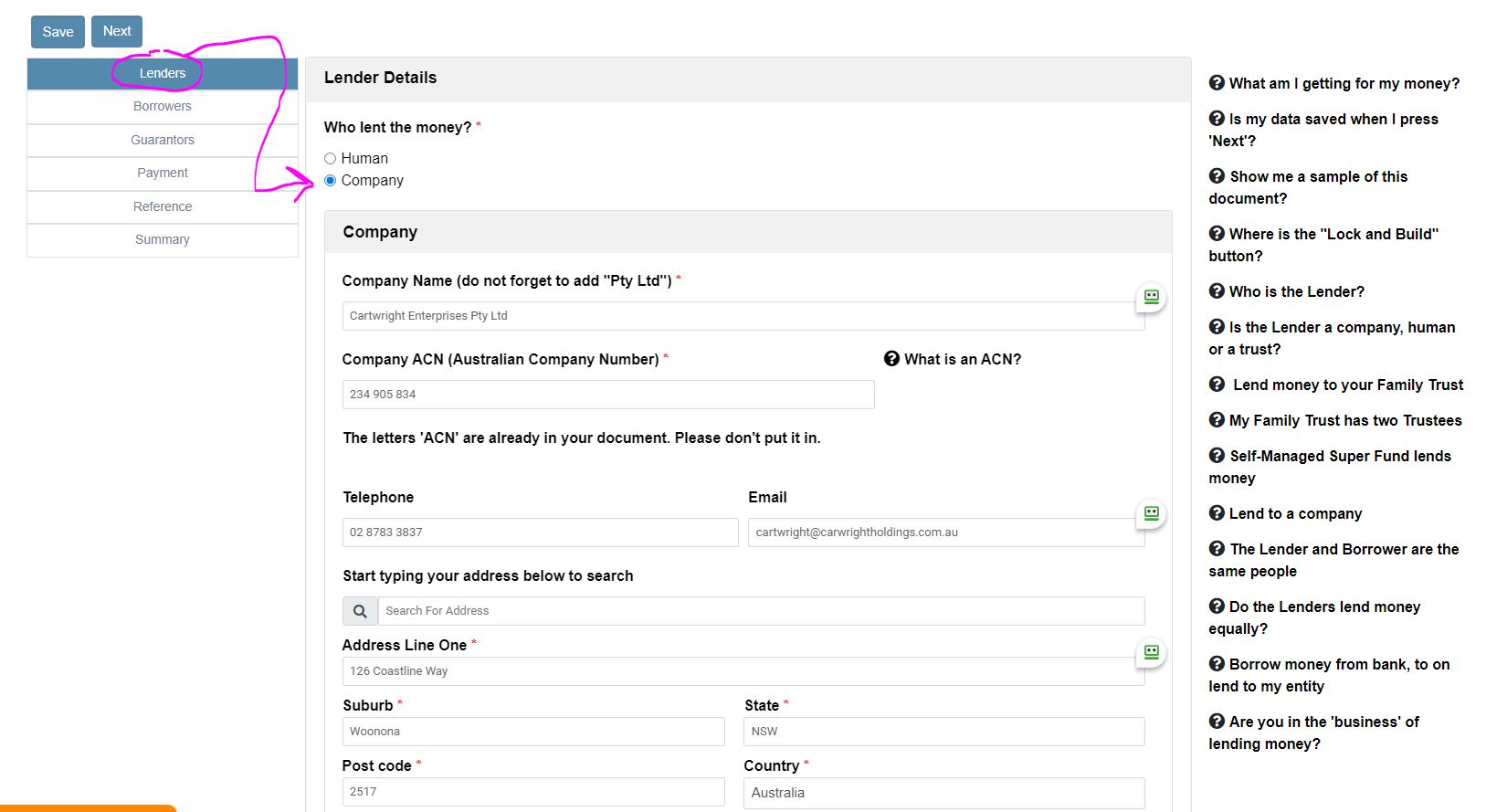
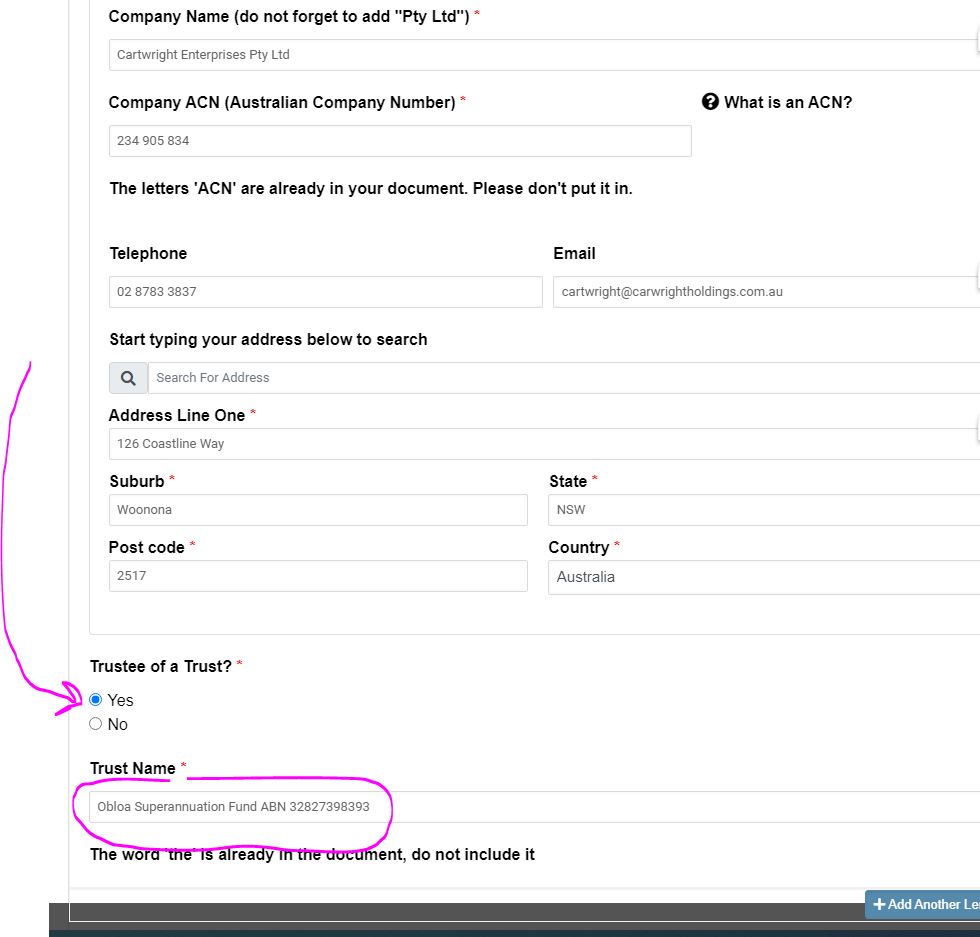
In this example, the Self-Managed Superannuation Fund has a company as its trustee. You tick 'yes' to the "Trustee of a Trust". And put in the full name of the trust. Put in the Australian Business Number (ABN) as well.
Protects from death duties, divorcing and bankrupt children and a 32% tax on super. Build online with free lifetime updates:



 Money POAs: NSW, VIC, QLD, WA, SA, TAS, ACT & NT