

Replace the Company Constitution
Congratulations, you are about to replace the company constitution on our law firm's website. Build everything you need, including:
- law firm letter - confirms we authored the document
- member minutes
- ASIC-compliant new constitution
Do I need to lodge my amended company rules with ASIC?
With a Legal Consolidated update of your Constitution, you:
- Do not send a copy of the new constitution to ASIC (unless you convert to a Special Purpose Company for a SMSF)
- There are also generally no ASIC fees.
Company Constitution vs Replaceable Rules
Companies are governed by:
- a constitution (recommended), or
- replaceable rules
We often review companies incorporated on non-law firm websites. To ‘save time,’ the non-law firm website adopts replacement rules for:
- a sole director, sole member company; or
- a Self-Managed Super Fund corporate trustee (special purpose company)
However, both must have a constitution.
Replaceable rules (from the Corporations Act 2001) provide a basic set of rules for your company. They are not good. Few accountants, lawyers or advisers recommend them.
Replaceable rules are less than the bare minimum. There are many additional powers that a company should have. These are only found in a constitution.
Replaceable rules change at the whim of the current government. While the changes may benefit ‘society’, they may not be in the best interests of shareholders. In contrast, shareholders amend constitutions anytime.
You are welcome to add your logo to our law firm's documents for free.
A new company directly with ASIC comes with no Constitution
Q: I have a new client. She went ahead and registered a new Company directly with ASIC. This is without talking to me first.
I asked her for all the Company details, including the Constitution. She said she didn’t get a Constitution. I am surprised ASIC did not require a Constitution during the process of incorporating a Company.
Does ASIC provide her with a Constitution? Or do I build a Constitution on Legal Consolidated's website?
A: The client is foolish for building their own company:
- for setting up a company without speaking to her accountant and financial planner first
- dealing directly with ASIC. ASIC is a government regulator. Like the ATO and other government agencies, only approach government regulators through your accountant and adviser
- ASIC only provides Replaceable Rules
- ASIC and the Australian government want you to have these dangerous Replaceable Rules. This is so governments can 'control' your company. The forever-changing, Replaceable Rules may, for example, in the future require:
- that you treat employees in a different way
- at least one Christian person as a director
- a higher standard over and above the requirements of the Modern Slavery Act 2018
- As governments change, Canberra, through the Replaceable Rules, may come up with all sorts of strange requirements. Do not let the government dictate its current fads onto your company. Build your new Company Constitution to escape government control. Keep autonomy with a Company Constitution. Merely build this new Company Constitution to escape the Replaceable Rules
https://legalconsolidated.com.au/bucket-company-for-family-trust/
Eight benefits when updating a Company Constitution with Legal Consolidated
The constitution you are building updates your company’s internal rules and procedures. It fully complies with the new changes to the Corporations Act. The eight benefits are:
1. No Technology in the old Company Constitution
Technology changes how boards communicate with employees and shareholders. Traditionally, board decisions are mailed to shareholders in physical form. The update reflects technology changes. The new constitution outlines how technology is used in meetings. Members do not need to attend meetings and can appoint a proxy.
2. Dividends confusing in old Memo & Articles
In 2010, the Australian government amended section 254 of the Corporations Act. This section governs how dividends are paid.
Before 2010, dividends were only payable from company profits. Now, a company can declare dividends if:
1. its assets exceed liabilities; and
2. the payment is fair and reasonable; and
3. the payment does not materially prejudice the company’s ability to pay its creditors.
Under old constitutions, you are not able to pay dividends. Insolvency specialists pursue this argument. They challenge all dividends paid since 2010.
3. Share buy-backs are allowed in the Legal Consolidated company constitutions
Share buybacks allow companies to repurchase their shares from shareholders. In Australia, there are five types: equal access, on-market, employee share scheme, selective buy-back and minimum holding. Replace the company constitution and ensure the buy-back is legal.
4. Preference shares in a Constitution
The new constitution allows the company to issue preference shares under Australian law.
5. Single Director not allowed in the old Memo & Articles
Before 1995, two directors were required. This was a disaster for asset protection. Both directors went bankrupt along with the insolvent company.
Asset protection is having no assets in a risky person’s name. Instead, assets are in the safe person’s name. For a couple, this is the 'man of straw and the woman of substance'.
Owe money to the ATO for PAYG or superannuation? All directors are automatically liable for these ATO debts.
The Law Reform (Miscellaneous Provisions) Act 1995 (Cth) reduces the minimum number of directors from two to one.
Now, most companies have a single director. Only one person goes down if the company is insolvent.
The new constitution you are building allows you to have a single director.
6. Directors cannot resign if two directors are required
As stated above, only a single director is required. However, there are over 27,000 Memorandum of Articles of Association and 59,000 constitutions that still require two directors.
We review brand-new company constitutions that are incorporated on non-law-firm websites. Many still require the company to have two directors.
What if your rules say there must be two directors, but one wants to resign? You lodge the correct form with ASIC to resign as a director. ASIC accepts the form. However, the resignation is void. This is against a company liquidator and a trustee in bankruptcy.
To rectify this, update your company rules on Legal Consolidated's website.
A company with insufficient officers breaches the Corporations Act 2001. You then suffer penalties and are prosecuted.
7. Division 7A Loan Agreement v's Memo & Articles
Your new Legal Consolidated Constitution contains a Division 7A Loan Agreement. It is part of the Constitution. It works for existing and future members. All shareholders are deemed to have the Div 7A Loan Deed.
8. Escape the company seal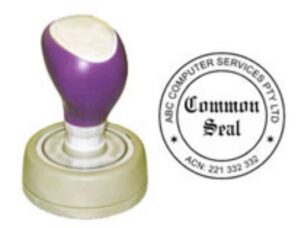
A "company seal" is a stamp. You apply the stamp on legal documents signed by the company. Many Constitutions require all deeds signed by the company to be "signed under seal". But the signing-under-seal rule has been abolished. No seal is required under the Company Law Review Act 1988 (Cth).
If your rules require a seal, then a deed signed without a seal is invalid. Our new update eliminates the seal requirement. Other names for a "company seal" are a "corporate seal" and "common seal".
Four faults in the old Constitutions, Memo & Articles of Association
Australian companies created before 1 July 1998 have a 'Memo & Articles of Association'. Like old Constitutions, your Memo & Articles of Association still operate. But not well. M&A faults include:
1. Mandatory Annual General Meetings each year
Many constitutions require AGM. If you fail to hold the AGM, your company is in breach. This is for both taxation and insolvency laws. The law no longer requires an AGM for Pty Ltd companies. Our update removes the requirement.
2. Memo & Articles only do as permitted
Stating a ‘list of objects’. This is the purpose of the company. E.g. ‘sell fishing tackle and retail’. What if your company now does something else, such as acting as a trustee of a doctor's surgery? Then you break the law. Your company is acting ‘ultra vires’. It is acting outside its powers. Again, your company is non-compliant. Legal Consolidated’s Constitution allows you to do anything a human can do – and more.
Q: But should not a Constitution contain a purpose statement (‘purpose clause’)? A: No. It should not. If you want to lock in some type of behaviour or fetter discretion, then build a Shareholders Agreement.
3. Two directors go bankrupt, instead of one
Requiring two directors. As stated above, the laws have changed. You now only need one director. It is safer to have only one director in case the company becomes insolvent.
4. Perform out-of-date and illegal actions
Old rules can force you to perform illegal actions. Instead, update the company constitution to allow these correct powers:
-
-
- exercise corporate powers
- issue and allot shares
- not avoid liability (a very strange rule)
- transfer shares
- vote and proxies
- appoint directors and company secretary
- conduct general and director meetings
- sign bank documents, loans and mortgages (however, this may be useful because banks often cannot enforce a loan made by a company that is still working under the old Constitution or M&A)
-
Q: Company constitution from non-lawyers. Statutory constitution?
A: Every Constitution is different. Hopefully, the accountant obtained the Company and the Constitution from a law firm. Look at the Company Constitution. It will have the name of the law firm that prepared the Constitution. If the Company Constitution is silent, then it looks like you and the accountant have been duped. Update the Constitution ASAP.
You use the expression "Statutory constitution". I think you mean "Replaceable Rules". For the reasons set out above, Replaceable Rules are bad (and illegal for SMSFs). Escape the risky replacement rules by building a Legal Consolidated Constitution.
Q: Difference between a constitution from Legal Consolidated and a non-lawyer?
A: Company Constitutions are deeds. Only lawyers can legally prepare deeds. You would not find an Australian accountant preparing a Deed. Instead, the accountant outsources the preparation of the Company Constitution to a law firm. Also, see the above answer.
Q: Does the Corporations Act control the Legal Consolidated constitution?
A: Sadly, your new Constitution (like your old one) is restricted by the legislation in the Corporations Act. Unlike trusts, companies are highly regulated. We are forced to draft the Constitution under Australia's highly controlling laws. The Corporations Act fetters what we can do to protect the company, its directors and shareholders.
So the answer is yes. As it has to be. But the Constitution you are building gives shareholders the greatest freedom the Commonwealth government allows.
Q: What does Legal Consolidated do with 'A Class management' shares?
Q: I have lost the Memo and Articles from the 1970s.
The founders' shares remain unchanged as:
- one A Class Governor’s Share - to the father; and
- one B Class Succeeding Governor’s Share - to his wife
- 10,000 C Class shares to the oldest child
- 10,000 C Class shares to the other child's company as trustee for that child's Family Trust
I have no idea of the rights of each class of shares.
Can I build a new company constitution with Legal Consolidated and not 'upset' whatever those rights may be?
A: You are correct. The Legal Consolidated Constitution update does not trigger any CGT or stamp duty. This is because the Constitution update does not change the powers and rights of the different classes of shares.
So that is that.
But, you are in a bit of a pickle as you do not know how to treat the shares in the payment of income and capital. You have been in that pickle for many years. I wonder how you have been declaring dividends and distributing capital without knowing these rights. The ATO is probably wondering as well.
While my guessing is not enough to appease your accountant, your lawyer, the ATO, stamp duty office, Family Court and Bankruptcy Court, I can tell you how, from my personal experience only, 100% of these are structured. Since I started practising in 1988, every single company with these share classes that I have reviewed is structured the same way:
-
One A Class Management shares - Dad
Dad has an absolute majority with this one share. All other shares get one miserable vote. Dad's management share outvotes everyone combined. But the share loses its 'management' powers upon Dad's death. It just takes on the qualities of a 'normal' C-class share.
-
One B Class Management share - Mum
At Dad's death, his wife's management share becomes the controlling share. It outvotes with an absolute majority of all other issued shares. But upon Mum's death, the share takes on the 'normal' Class C rights.
-
C Class shares - the children
These are just the 'normal' shares we have come to know and love in companies. One vote per share. All shares are ranked equally - pari passu.
Pari passu is a Latin phrase meaning "with an equal step" or "on equal footing".
The above allows you to escape the old death duties and probate duties taxes. That is probably why your grandfather and his accountant set up this shareholding in the first place. However, from 1983, because there were no such death duties in any Australian state, A Class Management shares fell out of favour. And since 1985, when the federal government introduced the Capital Gains Tax, it has become completely out of vogue.
What can you do when the company's rules are missing?
- First, update to a Legal Consolidated Constitution.
- Try to find the old Constitution, or in this case, the Memo and Articles of Association:
- do full historical searches with the ASIC - Australian Securities and Investments Commission. It may even have a copy on microfiche or microfilm
- hunt down old directors, past accountants, retired accountants and ex-spouses and offer a reward
- hunt down the law firm that prepared the company (e.g. at Legal Consolidated we keep a permanent copy of all your ASIC Constitutions, minutes and consents required to set up the company. You can log in any time to see and print out those records.)
- And thirdly, if the shareholders cannot muddle through or they start fighting, apply for a private ruling with the ATO as to what you think are the rights of each share. And then, if there is land, have that discussion with the stamps office. Good luck.
A joint tenancy was another way to avoid state probate duties. But that is not the best structure now that probate duty has been abolished and CGT has been introduced.
https://legalconsolidated.com.au/replace-lost-company-constitution/
Does Legal Consolidated's Constitution update the Shareholding and rights of the shares?
Q: I am at Lock and Build. I have answered all your questions. I love the Hints for each question. However, you have not asked for:
- the current shareholders; or
- the rights of each share class. (Our old rules allow us to have three classes of shares: Ordinary, A-Class and B-Class.)
I want to change the rights of some of the share classes.
A: You are correct. The updated set of rules - called a Constitution - does not change the shareholders. Nor does it change the rights of each class of share. (Read the above, in fact, read this whole page to get the full answer.)
However, the new Constitution gives you:
- many more classes of shares; plus
- the right to set up even more classes of shares
So enjoy yourself. After the Constitution update, you can do everything that you wish. However, remember you trigger Capital Gains Tax and Stamp Duty when you:
- Change or add to shareholders
- Change the rights of shares
So tread carefully.
The Constitution update does not change the current shareholders or the rights of each share class. Instead, it provides the opportunity to create additional classes of shares and set up more of them if needed. However, be cautious as changing or adding shareholders and altering the rights of shares trigger Capital Gains Tax and Stamp Duty. It is wise to approach such changes carefully and speak with your accountant first.
Why Consider Updating Your Company Constitution?
Why should you contemplate revising your company's constitution? Such a move ensures alignment with current legal standards, reducing the risk of non-compliance and potential legal conflicts.
What Advantages Arise from Company Constitution Updates?
What benefits stem from updating your company's constitution? The revision process brings clarity to governance structures, decision-making processes, and shareholder rights. As a result, internal operations improve, fostering better relationships with the ATO, members and creditors.
How Does the Constitution Update Enhance Flexibility?
How does updating the company's constitution increase flexibility? By incorporating provisions that allow for better adaptation to evolving business landscapes, changing market dynamics, and growth strategies, the Constitution becomes a more adaptable tool especially as Australian governments swing from Labor to Liberal - and vice versa.
Do Constitution Updates help Transparency?
Can the updating of the company constitution promote transparency? Indeed, such updates can introduce provisions that encourage transparency. These may encompass requirements for regular reporting, disclosure of potential conflicts of interest, and mechanisms for involving shareholders. These steps cultivate trust and accountability.
What Role Does Modernisation Play in Constitution Updates?
How does modernising the company constitution factor into updates? Modernising the constitution is crucial to ensure it remains in line with current best practices, technological advancements, and industry norms. This enables your company to stay competitive and compliant amid the ever-changing business landscape.