
-
SMSF Commercial Lease Agreement
-
$645 includes GST
- Build online in 14 minutes.
- Our free building process guides you every step of the way.
- Fully complies with SMSF laws.
Using your Self-Managed Super Fund (SMSF) to lease your business premises is a powerful strategy. However, the Australian Taxation Office (ATO) imposes a strict and complex legal framework. A standard commercial lease is dangerously inadequate and leads to severe penalties.
Our law firm's lease is built to provide you with a compliant, audit-ready safeguard for your retirement savings, meticulously drafted to comply with Commonwealth superannuation law.
✅ ATO & SIS Act Compliant: Specifically designed to comply with the Superannuation Industry (Supervision) Act 1993 (SIS Act) and its regulations.
✅ Avoids the 45% NALI Tax Trap: Ensures your lease is on an 'arm's length' basis to protect your fund from the punitive non-arm's length income (NALI) rules under s295-550 of the Income Tax Assessment Act 1997.
✅ Audit-Ready: Provides the clear, legally enforceable paper trail your SMSF auditor requires to verify compliance every year.
✅ Legally Enforceable: Drafted by our Australian law firm to be a robust, legally binding agreement, giving you certainty and protection.
Failing to meet the ATO's strict requirements or act at arm's length leads to:
45% Tax on All Income: All rental income and capital gains from the property are taxed at the highest marginal rate under the NALI rules.
Trustee Fines & Disqualification: The ATO imposes personal fines on you as the trustee and disqualifies you from acting as an SMSF trustee or director of an SMSF corporate trustee.
SMSF Deemed Non-Complying: In serious cases, your entire SMSF loses its complying status and a penalty tax is levied on the entire value of the SMSF.
Forced Sale of the Property: Your fund is directed by the regulator to dispose of the property to rectify a breach.
Our Legal Consolidated SMSF Commercial Lease is your compliance safeguard. Built by our law firm and designed specifically to navigate the complexities of the SIS Act and Tax Act, it provides the legal certainty and peace of mind you need.
The primary risk for an SMSF leasing commercial property is failing an ATO audit. Our lawyer-drafted leases are specifically designed to provide the evidence and paper trail your SMSF auditor needs to see. We transform these complex rules from a risk into a feature of our document, ensuring every requirement is met :
Our online platform is designed to educate you as you build your document. By answering the questions, you learn about the critical information required for a compliant SMSF lease.
Why cannot I use a standard commercial lease from a real estate agent? A standard lease does not contain the specific clauses required under the SIS Act. It won't address the 'arm's length' rules or provide the necessary evidence for an SMSF auditor, putting your fund at significant risk of non-compliance.
What happens if I do not have a compliant lease? The ATO can declare the lease an 'in-house asset'. This can lead to significant penalties, including forcing the sale of the property and potentially deeming the fund non-compliant, which has major tax consequences.
Does this lease work for all of Australia? Yes. Our lease is drafted to comply with the federal SIS Act and includes the necessary clauses for individual Commercial Tenancy legislation in Australian states and territories.
Can I update the lease later? Yes. Uniquely, the lease contains provisions for rent reviews and other variations, including via an exchange of emails. If you need to make a significant change, you can build a Deed of Variation of Lease on our website or build a new lease.
Since 1988, we have been a trusted Australian law firm dedicated to providing accessible, compliant, and strategic SMSF legal documents. Our team consists of specialist lawyers and tax professionals who are experts in their fields. Unlike a template website, we are a fully regulated law firm. Every document you build is backed by our legal expertise and professional indemnity insurance, giving you unparalleled peace of mind. We provide documents to over 3,800 financial planners, lawyers, accountants and clients across Australia.
Take the first step towards securing your fund's compliance. Start building your draft lease now—it's free to begin, and there is no obligation.
An accountant shows me a non-complying, self-managed super fund that owns commercial property. The problem? The SMSF does not have a legally drafted commercial lease. Although the lease complied with the law, it did not address the requirements of the SIS legislation and failed the ATO audit.
Your SMSF Commercial Lease Agreement must comply with both the state laws and the Commonwealth Superannuation law. If your SMSF is non-compliant, the ATO applies penalties and additional taxes.
SMSFs require specialist leases. The commercial lease should be subservient to the Superannuation rules. It is not enough to use a standard commercial lease. Legal Consolidated’s SMSF commercial lease complies with the SIS Legislation.
Our SMSF Commercial Lease is designed for SMSFs. However, if your SMSF is leasing the commercial property to a non-related party, the Lease must still comply with the SIS Legislation.
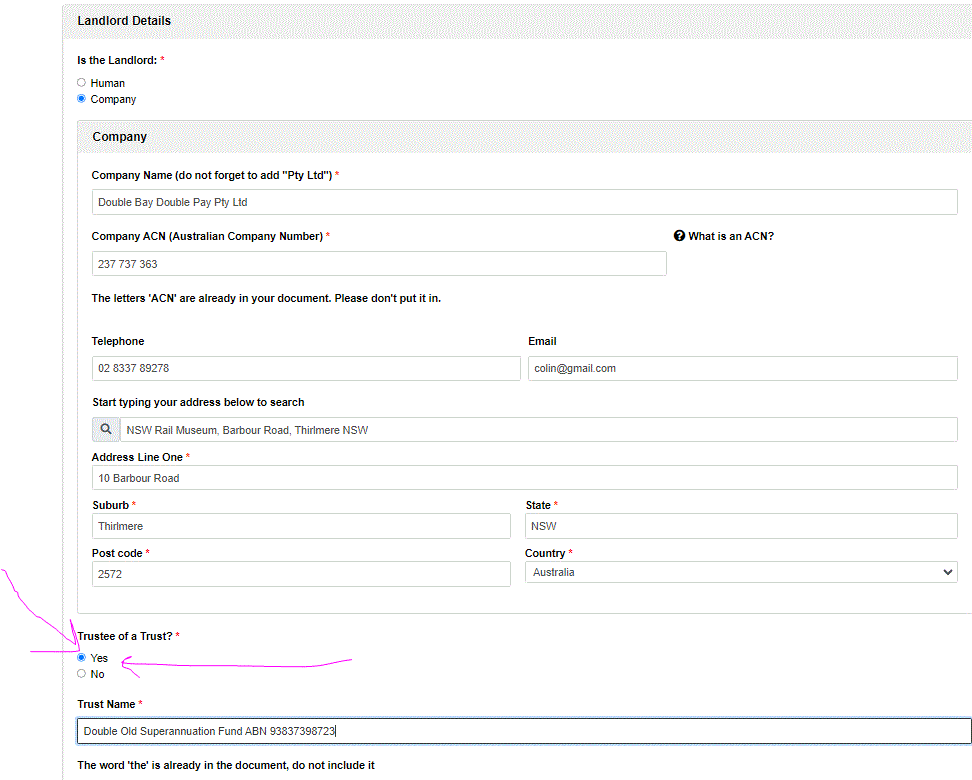
The SMSF has a company as the trustee. The company is the Landlord. Select Yes to Trustee of a Trust. Type in the name of the SMSF and its ABN.
There are additional challenges when leasing to a member. For example:
1. Member gains an advantage from the SMSF. For example, the rent charged by the SMSF is too low. A member illegally gains an advantage.
2. The member gives an advantage to the SMSF. For example, the rent is too high, so the member illegally injects funds into the SMSF. This is a contribution by the member or a ‘related person’.
Therefore, the lease between the SMSF and the member must be at arm’s length. The SMSF cannot give ‘special treatment’ to a related party in the commercial lease. The trustee cannot give ‘favours’ to the leasing member.
You must have:
1. a legally prepared and legally enforceable written lease agreement – designed for the SIS legislation
2. rent paid on time as required by the Commercial Lease Agreement
3. the SMSF taking appropriate action to remedy breaches
Our firm’s Commercial Lease Agreement complies with up-to-date Superannuation law, including:
* Superannuation Industry (Supervision) Act 1993
* Superannuation Legislation (Consequential Amendments and Transitional Provisions) Act 2011
* Superannuation (Financial Assistance funding) Levy Act 1993
* Superannuation (Resolution of Complaints) Act 1993
* Superannuation (Rolled-Over Benefits) Levy Act 1993
* Superannuation Industry (Supervision) Consequential Amendments Act 1993
* Superannuation Supervisory Levy Amendment Act 1993
* Occupational Superannuation Standards Amendment Act 1993
* Superannuation Act 2005
* Superannuation Act 1990
* Superannuation Act 1976
* Superannuation (Productivity Benefit) Act 1998
* Superannuation Benefits (Supervisory Mechanisms) Act 1990
* Superannuation (Family Law – Superannuation Act 1922) Orders 2004
* Superannuation (Family Law – Superannuation Act 1976) Orders 2004
* Superannuation Guarantee (Administration) Act 1992
* Superannuation Industry (Supervision) Regulations 1994
SMSF auditors require a copy of the lease before signing the yearly audit.
Our law firm’s SMSF commercial lease complies with the Superannuation laws, enhancing regulatory adherence. We also make the auditor and ATO auditor happy (well, as much as they can be).
When your Self-Managed Super Fund leases property – especially to a related party – the law is strict. A poorly drafted lease can trigger breaches, tax penalties, or even SMSF disqualification.
Legal Consolidated’s SMSF Commercial Lease Agreements are built by Australian lawyers to comply with every relevant law. We follow the Acts and sections that the Australian Taxation Office and your SMSF auditor check first.
1. Superannuation Industry (Supervision) Act 1993 (SIS Act) The main law controlling SMSFs. Our leases comply with:
Section 62 – Sole Purpose Test – lease must solely benefit members’ retirement savings.
Section 65 – prohibits giving financial assistance to members.
Section 66 – limits buying assets from related parties.
Section 71 – defines in-house assets to avoid.
Section 109 – requires all leases to be on arm’s-length terms.
2. Superannuation Industry (Supervision) Regulations 1994 Contains the technical rules that SMSF auditors check:
Regulation 8.02B – all rent must be supported by market valuation evidence.
3. Income Tax Assessment Act 1997 – Non-Arm’s-Length Income (NALI)
Our leases prevent this risk by locking in arm’s-length, market-tested terms.
4. State and Territory Property Laws
Stamp Duty Acts – Our leases are structured to avoid unintended duty liabilities.
Property Law / Conveyancing Acts – Ensures enforceability and compliance in your state.
Commercial Tenancy Acts – Keeps your SMSF in line with state-specific commercial leasing rules.
5. Corporations Act 2001
Our leases meet Chapter 2E rules on related-party transactions.
Audit-ready – Your SMSF auditor will have no reason to qualify their report.
ATO-compliant – Avoids fines, penalties and 45% NALI tax.
Peace of mind – Every term is built for SMSFs and updated for changes in the law.
One fixed price – We include all the clauses you need from day one.
Our SMSF Commercial Lease Agreement:
As the end of the financial year approaches, your accountant may advise prepaying expenses, such as rent, to increase deductions and reduce your taxable income. Commonly, in arm's-length lease agreements, tenants will approach the landlord to make advanced payments. Legal Consolidated Commercial Leases expressly allow for this. It is written into the Commercial Lease Agreement.
However, while common in arm's-length leases, the SMSF Commercial Lease has the additional burden of needing to be both seen and actually acting on an arm's-length basis.
A common question is whether a tenant (SMSF member) can prepay rent—sometimes up to 12 months in advance—to their SMSF Landlord. This strategy can be particularly attractive when the tenant's personal tax rate (e.g., 47%) is significantly higher than the SMSF's tax rate (e.g., 15%). However, all dealings must remain at arm's length to comply with superannuation laws.
You must satisfy both your SMSF auditor and, if audited, the Australian Taxation Office (ATO). We do not give advice in this area, but your accountant will want to see that any prepayment is a legitimate, arm's-length transaction. Your accountant would need to sign off on the forward paying of rent. While Legal Consolidated Commercial Leases expressly allow for advance payment of rent to the landlord, it does not mean that you can do so under the SMSF rules. Speak with your accountant.
The Tenant has no authority to sublet or assign under this Lease. This is unless the Landlord and Tenant mutually agree, subject to the Superannuation laws. The ‘waive and variation’ clause permits subletting and assignment — but is subject to the Landlord's consent.
If the Tenant (member) defaults on payment, the landlord (SMSF) recovers liquidated damages from the Tenant. It is important that this is not a 'contribution' to the fund. Our unique formula calculates damages that avoid 'contribution breaches' by the SMSF.
Without these pre-liquidated damages calculations, a commercial lease breaches the Superannuation law. Most Commercial Leases breach Superannuation laws.
Many lease agreements cannot be updated. However, if the Superannuation laws change, then this may render your SMSF non-complying. You suffer penalties of up to half the value of your SMSF.
With our lease, the Landlord and Tenant can exchange emails to alter the Commercial Lease.
Consider a 'sub-lease' and an 'assignment of lease':
Subleases and lease assignments are common and legal. However, when an SMSF leases commercial real property, building a brand new Commercial Lease is better.
Under the SIS regulations, sub-leases and lease Assignments may be considered too complex or confusing. The SMSF auditor may want to investigate further, ask the SMSF for more information, and get external consultants to sign off on the chain of events.
If you can, then a new SMSF Commercial Lease is simpler and safer.
If the 'business real property' is leased, your auditor looks for an up-to-date:
This is especially true if the SMSF is leasing to related parties. Ensure the lease is on an arm's length basis. You need fair market rent. Otherwise, the SMSF is taxed at 45% on its non-arm's length income.
An SMSF can not borrow money because it is considered too risky. However, there are exceptions to this rule. One exception is borrowing money through a 'Bare Trust' (Custodian Agreement).
In a property transaction involving an SMSF and a bare trust, the landlord is typically the bare trust's trustee, not the SMSF's trustee. The bare trustee holds the property title and acts as the landlord until the loan is repaid and the property is transferred to the SMSF.
Every superannuation law firm has its own view on how a Commercial Lease is set up when a Limited Recourse Borrowing Arrangement (LRBA) is in place.
An SMSF borrows to buy a property through a bare trust called a Custodian Trust. The Custodian Trust holds the property as a bare trustee for the SMSF. The Trustee of the Custodian Trust is the 'legal owner' of the property. Eventually, if and when the loan is paid off, the property is transferred into the name of the Trustee of the Self-Managed Superannuation Fund.
Legal Consolidated's Commercial Lease has the landlord as the trustee of the Custodian Trust (i.e., the trustee of the Bare Trust). In other words, the Trustee of the SMSF is not the Landlord. The Legal Consolidated SMSF Commercial Lease helps manage the eventual transfer of property to the SMSF. This is how it works:
We have found that this approach satisfies both your auditor and the regulator, the Australian Tax Office.
An auditor has argued that an SMSF Commercial Lease must always have an 'automatic transition' clause. Legal Consolidated SMSF Commercial Lease always do. However, we have reviewed the law and the ATO's rulings on this, and we are of the view that while an 'automatic transition' clause is best practice and 'pleases' the ATO, it is not a mandatory requirement in an SMSF Lease.

Here is an example of a Commercial Lease where the SMSF is gearing the property through a Limited Recourse Borrowing Arrangement (LRBA):
If the commercial property is in a Bare Trust, the trustee of the Bare Trust (only) is the Landlord. (The Trustee of the SMSF does not become the landlord until the property is finally transferred out of the bare trust to the trustee of the SMSF.)
Here is another example:
When the happy day comes that the property is paid off, then the property is transferred to Black Nominees Pty Ltd atf the George and Jenny Superfund. The Legal Consolidated SMSF Lease automatically caters to and allows for this future event.
Press the PDF above to see our cover letter and a sample of a Commercial Lease for an SMSF.
Service trust and Independent Contractors Agreements