
| Three common bare trusts you can build | |
|---|---|
| Acknowledgement of Trust Deed - 'AFTER the Trustee buys' | |
| Declaration of Trust BEFORE you buy - 'secretly buy' | |
| SMSF Custodian Bare Trust Deed - SMSF borrows money |

| Three common bare trusts you can build | |
|---|---|
| Acknowledgement of Trust Deed - 'AFTER the Trustee buys' | |
| Declaration of Trust BEFORE you buy - 'secretly buy' | |
| SMSF Custodian Bare Trust Deed - SMSF borrows money |
Here is an example of a 'trust':
Beneficiaries of trusts are protected. For example, if you, as the Trustee, go bankrupt or get a divorce, then the trust asset, being the bank account, is not lost.
The bank account is held in your son's name, who, as the beneficiary, is the 'true' owner of the asset. The courts and the ATO 'look through' the trust to see who the 'true' owner of the assets is. In this case, the 'true' owner is your son - not you.
Most people who own an asset hold both the legal and beneficial interests in it. There is no trust if you hold both the legal and beneficial ownership. In contrast, in a trust, the legal and beneficial interests are held by different people:
A trust automatically exists when you separate the 'legal' and 'beneficial' ownership.
If your son, at 18, removes you as the Trustee and puts himself in as the legal owner, then the trust is finished. It is extinguished. This is because your son now holds both the 'legal' title and 'beneficial' interest. The split of the ownership has gone. The trust relationship no longer exists.
After the Trustee and Beneficiary, the third requirement for a trust to exist are the Trust Assets.
The trust assets can be anything. Trust assets may be real estate, shares, artwork, cars, bank accounts and cash.
The four most common trusts in Australia are:
A trustee who has no discretion and whose only active duty is to convey the property at the direction of the beneficiary or beneficiaries is a “bare trustee”. See Gummow J in Herdegen v Federal Commissioner of Taxation (1988) 84 ALR 271, 37.
No, for an SMSF Bare Trust. Yes, a Bare Trust can hold an asset for more than one beneficiary.
E.g. 14,000 BHP shares for John Smith, Mary Smith and Smith Nominees Pty Ltd.
However, the problem is how many shares does John own? How many does Mary own? And how many does the company own? You would need to have a minute setting out the number of shares each of those three persons owns. Or prepare three separate Bare Trusts.
A Bare Trust is the relationship between the trustee and the beneficiary. It does not document the relationship between the beneficiaries themselves.
Under Australian trust law, the trustee must act in the best interest of the beneficiary. The trustee cannot break the faith and provide information to third parties. To do so is a breach of faith.
To act ‘in good faith’ is to act honestly or sincerely. This is without an intention to deceive or hurt the beneficiary. This is also known as acting bona fide.
Each law firm builds its bare trust deeds differently. But in a Legal Consolidated bare trust deed, it is illegal for a trustee to accept payment (a bribe) to release the identity of the beneficiary. Confidentiality is often the main reason why you set up a bare trust in the first place.
For example, you may wish to hide the true owners from competitors, the press and other stakeholders in the same or similar industry.
Of course, an Australian law may override this. Further, the Courts, Family courts, Bankruptcy courts, ASIC and the ATO require full disclosure.
Shareholders' Agreements and Unitholders Agreements also override confidentiality. They require the trustee to disclose trust owners under the terms of the agreement the trustee signs.
Further, it is usually pretty obvious to the ATO who the beneficial owner is. This is because the beneficial owner must, by law, disclose taxable income from the asset being held in trust on their personal tax return.
This is an interesting article about the trustee's attempts to keep secrets from the beneficiary.
If you are talking about confidentiality, then it would make no difference whether you have a human trustee or a corporate trustee.
If you are talking about asset protection, then, yes, a company as a trustee provides better insolvency protection.
Q: The Bare Trustee is going to hold some listed shares. This is in trust for the Trustee of a Family Trust.
What will show on the shareholders' register?
A: Generally, the public listed shareholders' register just shows the Bare Trustee name. But there may be a legal requirement to make a disclosure to the company. This is even more likely if the company's shareholding is large. Check with your accountant.
Consider the two most popular 'bare' trusts in Australia:
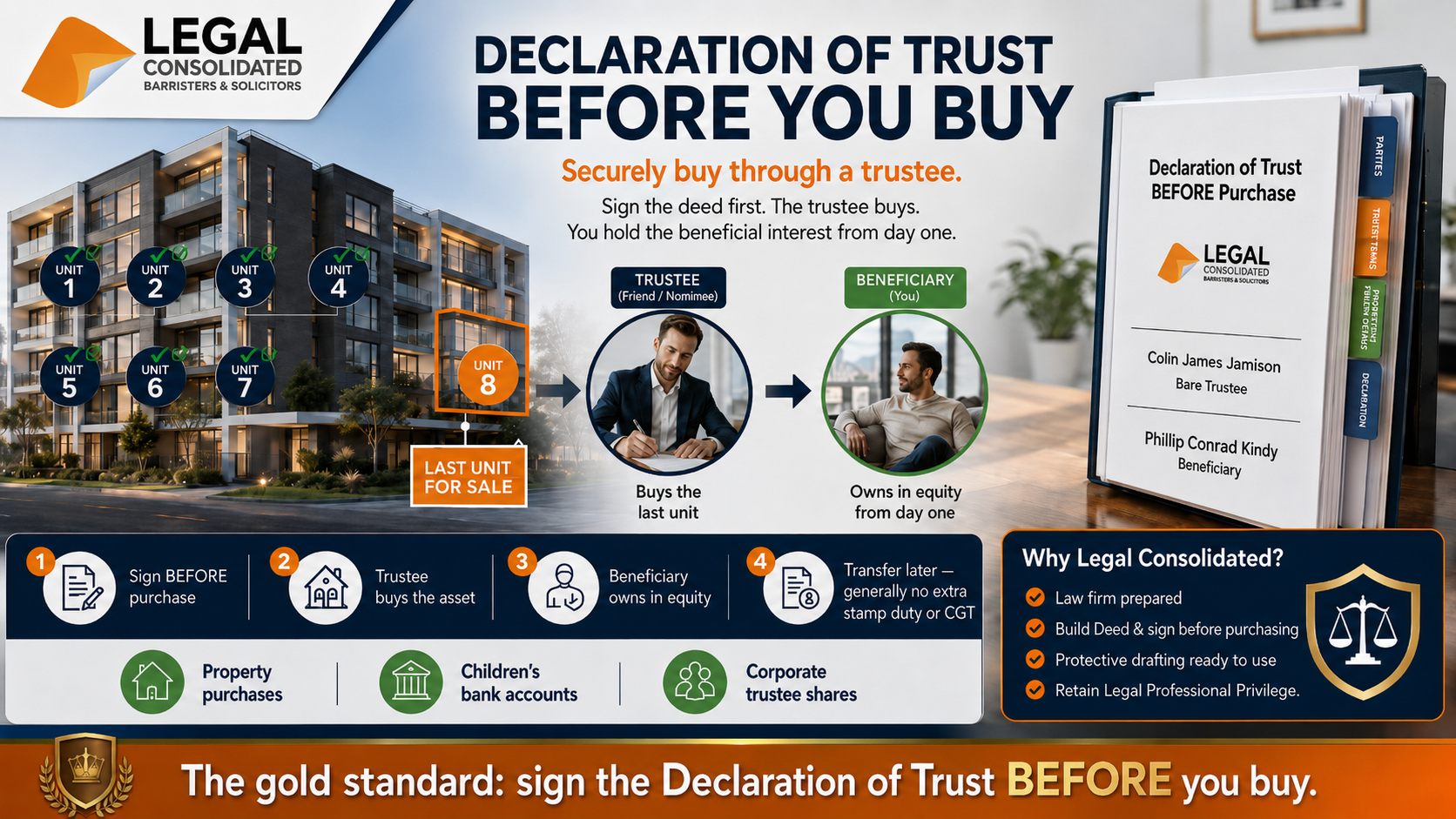
You sign a Declaration of Trust BEFORE you make an offer to buy something:
You own 7 of the 8 units in the same block.
The last unit finally comes onto the market. The vendor knows that you own all the other units. He smugly is going to hold out for a lot of money. But you never approach the vendor.
Instead, you get a friend to sign a Declaration of Trust Before Purchase. Your friend is the Trustee. You are the beneficiary.
Armed with the duly signed Declaration of Trust, the Trustee presents an offer to purchase the unit to the vendor.
Upset that you never made an offer to buy the flat, the vendor sells the flat for 'nothing'.
The vendor sells the home to your friend. The vendor is unaware that you are the true purchaser.
Your friend delivers the contract of sale to you. Using the Declaration of Trust Before Purchase, the property settles in your name for no additional stamp duty or any CGT. The vendor is furious. But there is nothing he can do.
You are the 'true' owner. At any time, the beneficiary can direct the Trustee to transfer the asset to the beneficiary. There is generally no stamp duty or Capital Gains Tax (CGT) for the transfer from the Trustee to the Beneficiary. But Legal Consolidated is not providing taxation advice on this. Speak with your accountant and tax adviser first.
Build the Declaration of Trust Before Purchase the property here.
Each state has its own Transfer (Stamp) Duty rules:
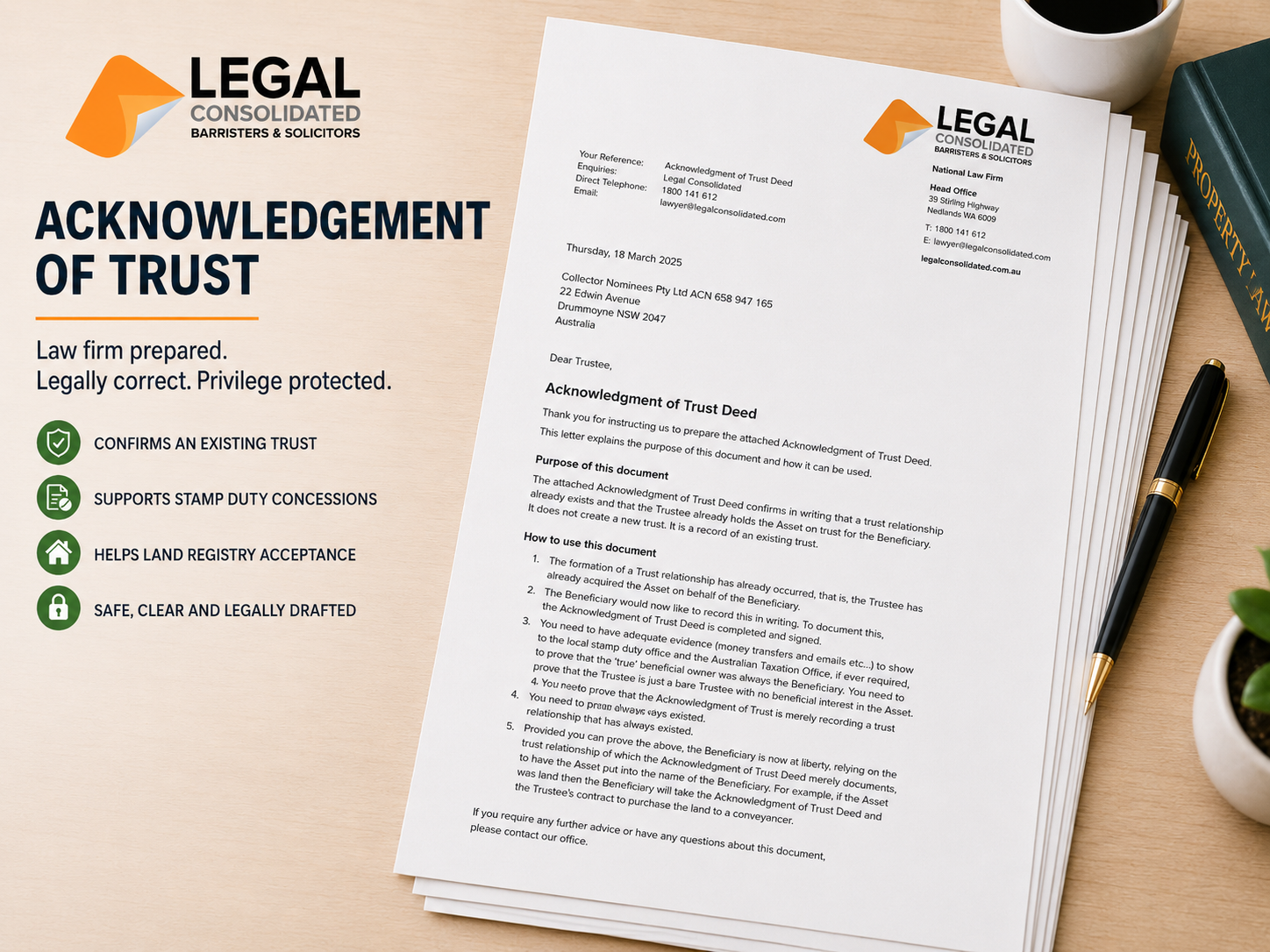 'better late than never'
Sometimes, in the heat of the moment, you forget to sign a Declaration of Trust Before Purchase.
While your Trustee proceeds to buy the asset for you, there is no deed yet to record that trust relationship. Trust relationships can exist whether they are in writing or not. They are much easier to prove if everything is in writing.
Whether there is a deed or not, the Trustee still 'owns' the asset merely as a Trustee for another person, being the beneficiary.
But without a Deed, you face an uphill battle 'proving' that you are the trust owner (beneficiary). And that your friend (trustee) is a mere trustee of the asset. These four people will call you a liar to your face. It is your job to have evidence to prove them wrong:
'Nice try. But only after your precious son decides to get a divorce do you, as his parents, try some feeble argument that the property in your son's name actually belongs to you.' sarcastically states the Family Court judge.
You can not argue both a bare trust and a loan.
The parents should have had their son sign the above Declaration of Trust Before you Purchase. But you did not. So now you are building the second-best document. You build the Acknowledgement of Trust.
(Alternatively, you could have lent the money to your son. But again, you should do that before you actually lend the money.)
What about Family Trusts vs the Family Court?
Your business is going under. Hang on a minute. You hold the family home as a bare trustee. After all, the money for the home came from your wife's bank account.
Well, that argument may or may not work. You should have signed a Declaration of Trust Before you Purchase (or a Spouse Loan Agreement). But you didn't. So now you have to build the poor cousin: Acknowledgement of Trust.
You will need more evidence of the bare trust, than the fact, that the money for the home came from your wife.
You told your accountant nine years ago that while the farm is in your name you are just a bare trustee. This is for your dad. You, the son, are the bare trustee. Your dad is the true owner. Your dad is the sole beneficiary.
There are three requirements for a bare trust. They are:
So you claim a bare trust. But you have to prove that. What evidence do you have? Where are the letters, emails, cheque butts, transfers of money to prove the trust relationship?
The ATO does a random audit. The ATO hears your story. Not a problem says the ATO. Just show me the Declaration of Trust Before Purchase. But, sadly, you and your dad never did one.
It is never too late to now build an Acknowledgement of Trust. It may not work. But it is the best you can do.
What if you cannot prove that dad is the true owner? Then the farm's income is put on your personal tax return. The ATO amends your old tax returns, accordingly. The ATO adds interest on this 'late' tax. (This is called the General Interest Charge - GIC.) The ATO also imposes a 200% penalty. Unable to pay the ATO bankrupts you and sells the farm.
You have been holding the block of flats in Double Bay, Sydney, on behalf of your brother.
Thankfully, your brother now directs, as the beneficiary, for you to transfer the property into his name. As the sole beneficiary, he has the absolute right to do this. And you must comply with trust laws.
You turn up to have the transfer 'stamped' at the local State Revenue Office. There is no transfer duty when trustees transfer property to the sole beneficiary.
"That's right", states the stamp duty man. "Just show me your Declaration of Trust Before Purchase. And I will stamp your transfer for free."
However, Legal Consolidated is providing no tax or stamp duty advice. Speak to your accountant and tax adviser before you sign.
If you do not have a Declaration of Trust Before Purchase, then consider an Acknowledgement of Trust.
It is never too late to build an Acknowledgement of Trust AFTER you buy.
Obviously, it is better to sign an Acknowledgement of Trust BEFORE the ATO, stamp duty office, family court and bankruptcy Court start their attack.
The Acknowledgement of Trust may not work. But it is the best you can do.
The Acknowledgement of Trust is drafted by the Trustee after the purchase. The Acknowledgement of Trust does nothing other than document what has happened in the past. It is not trying to rectify or change anything. It merely records what actually happened in the past. Or, more correctly, what you believed happened in the past.
It would have been better to have documented this trust relationship before the Trustee acquired the asset. Before the Trustee acquired the asset you should have built and signed a Declaration of Trust Before Purchase. But you did not. So you are now documenting what you did in the past with an Acknowledgement of Trust. It is better late than never.
The Acknowledgement of Trust merely sets out (your recollection of) the facts that took place in the past. As an example, you may say:
'Yes, as a Trustee, I acquired the asset, but it was, at all times, for the benefit of the beneficiaries. I have no interest in the asset other than as the Trustee. The money to pay for the asset came from the beneficiary, not from me. And I have plenty of evidence like cheque butts and emails to prove this.'
All the Acknowledgement of Trust is doing is recording, by way of Deed, the trust relationship that already exists.
There is a real risk that the state stamp duty office or the ATO may not believe you and seek to impose stamp duty and CGT on the Acknowledgement of Trust Deed. Be careful. Make sure you have plenty of evidence that at all times the beneficial owner was and remains the beneficiary (cheque stubs, bank statements, emails, etc.)
You need to prove that this Acknowledgement of Trust changes nothing. You were always the Trustee of the asset for the beneficiary. You need evidence that it has always been the case.
Why did the beneficiary want you, as Trustee, to acquire the asset as Trustee in the first place? There are many reasons. These are both personal and private. For example, the beneficiary may have wanted you to buy the asset as Trustee because the beneficiary didn't want the vendor, the public or a spouse to know what the beneficiary was up to.
| Build these Trust Deeds online | |
|---|---|
Family Trust |
|
| Family Trust Deed – includes a free Bank Solicitor’s Certificate (worth $1,250), over 18,000 sold | |
| Family Trust Updates: | |
| 1. Everything – Deed, Appointor and Trustee (recommended) – includes succession planning & Bank Solicitors Certificate | |
| 2. Upgrade the Family Trust Deed only – streaming, Bamford, trust law & tax | |
| 3. Change the Appointor – includes succession planning | |
| 4. Replace the trustee only | |
| 5. Change Name of the Family Trust | |
| 6. Exclude a Beneficiary in the Family Trust | |
| 7. Exclude Foreigners in the Family Trust | |
| Company – Trustee of a Family Trust – corporate trustee for asset protection & business | |
| Company – Bucket Company – beneficiary of a Family Trust | |
| Annual Distribution Minutes for Family Trust – sign minutes before 30 June | |
| Forgive Family Trusts’ UPEs – human forgives money the Family Trust owes (UPEs & loans) | |
| Deed of Gift – to prove the money you put into your Family Trust was a gift (not a loan) | |
| Division 7A Loan Deed – company lends trust money to Family Trust (UPEs & loans) | |
| Loan Agreement – lend money to your Family Trust | |
| Vesting Deed – wind up your old Family Trust (Centrelink compliant) – dissolve and close your Family Trust | |
| Training Course on Family Trusts – includes the Family Trust Deed | |
Unit Trust |
|
| Unit Trust Deed – pre-emptive rights, asset protection and free bank certificate | |
| Vesting Deed – to wind up your Unit Trust | |
| Company to be trustee of a Unit Trust – corporate trustee for asset protection | |
| Update the Trustees of the Unit Trust – remove and replace the trustee of your Unit Trust | |
| Change the Name of your Unit Trust – update the name of your Unit Trust | |
| Unitholders Agreement – the Unitholders’ set of rules that also protects them from litigation | |
Bare & Secret Trusts |
|
| Bare Trusts: | |
| 1. Acknowledgement of Trust Deed – ‘AFTER the Trustee buys’ | |
| 2. Declaration of Trust BEFORE you buy – ‘secretly buy’ | |
| 3. SMSF Custodian Bare Trust Deed – SMSF borrows through a bare trust |
Free articles on Australian trusts |
| Can I be a beneficiary without knowing? |
| Can I reject income from a family trust? |
| Do I mention my Family Trust in my Will? |